The best Hermes Agent memory provider for most people is Holographic: it is free, keeps every fact in a local SQLite file, needs no API key and adds a fact store tool with trust scores on top of the built in MEMORY.md and USER.md. Pick Mem0 instead if you want facts pulled out of chats for you with no curation, Honcho if one assistant serves many people or profiles and should model each of them, and Hindsight if you want a knowledge graph with a reflect step. Start with no provider at all if a few dozen facts cover what your agent needs.
That recommendation comes from how Hermes treats providers, not from a benchmark. Hermes always keeps its own small memory files active, and you can add exactly one external provider beside them. So the real question is what the extra layer should hold and where that data should live. Below is what each option does, what we saw when we ran Holographic on a test install, and how to switch.
How memory works in Hermes Agent before you add a provider
Hermes Agent is the open source agent from Nous Research, released under the MIT license on GitHub. Its built in memory is two files in the Hermes home folder. MEMORY.md holds the agent's notes about your environment and is capped at 2,200 characters. USER.md holds your profile and is capped at 1,375 characters. Both are loaded into the system prompt as a frozen snapshot when a session starts, so a fact saved mid session shows up in the next session, not the current one.
The caps are strict. When a write would go over, the memory tool returns an error and the agent has to merge or remove entries before trying again. Hermes also stores every past session in a local SQLite database with full text search, and the agent can query it with session_search when it needs something older.
For a single developer on one machine that is often enough. A provider becomes worth it when you have more facts than the caps allow, when several people talk to one gateway bot, or when you want ranked recall instead of a fixed block in every prompt.
Hermes Agent memory providers compared
The memory providers guide lists these options. Only one can be active at a time.
| Provider | Where data lives | Cost | Tools | Best fit |
|---|---|---|---|---|
| Holographic | Local SQLite file | Free | 2 | Private, offline fact store |
| Mem0 | Mem0 Cloud, your own Mem0 server, or in process | Free plan or self hosted | 4 | Hands off fact extraction |
| Honcho | Honcho Cloud or self hosted | Paid cloud or free self hosted | 5 | Modeling each user and profile |
| Hindsight | Hindsight Cloud or local | Paid cloud or free local | 3 | Knowledge graph and reflect |
| OpenViking | Your own server | Free (AGPL 3.0) | 6 | Browsable knowledge tree |
| Supermemory | Supermemory Cloud or self hosted | Paid cloud or free self hosted | 4 | Profile recall per session |
| ByteRover | Local, optional cloud sync | Free locally | 3 | CLI based knowledge tree |
| RetainDB | RetainDB Cloud | $20 a month | 10 | Teams already on RetainDB |
| Memori | Memori Cloud | Memori pricing | 5 | Structured recall with attribution |
Most of these now come from the plugin catalog instead of shipping inside Hermes. The docs say Hindsight, Honcho, Supermemory, Mem0, OpenViking and Holographic moved to their maintainers' own repositories, and that RetainDB and ByteRover were scheduled to leave core on October 15, 2026, with their standalone repositories unmaintained and open for a new maintainer. The v0.23.1 source we ran still bundled those two and nothing else. Treat that as a reason to prefer a provider with an active maintainer.
Why Holographic is the default pick
Holographic stores facts in memory_store.db inside your Hermes home. Its plugin repository says that by default there is no API key, no network and no model call; search by meaning through an embeddings API is an optional add on that is off unless you turn it on. Nous Research handed it to a community maintainer in October 2026, and the provider name, settings and database stayed the same, so existing setups carry over.
It gives the agent two tools. fact_store adds, searches, probes and updates facts, and fact_feedback rates a fact as helpful or unhelpful, which moves its trust score. The Hermes docs list the steps as plus 0.05 for helpful and minus 0.10 for unhelpful.
What we saw when we ran it
On our test install we stored "Dana prefers pnpm over npm for every repo", a note about a staging database on port 5433, and then the opposite preference, "Dana prefers npm over pnpm". The third write was saved, but the reply flagged the first fact as similar (word overlap 1.0) with a hint to forget the new fact and change the old one if the preference had changed. The contradict action, run right after, returned zero results for that pair, and a search for which package manager Dana uses returned both facts at the same trust. So the plugin warns at write time, but your agent still has to act on the warning.
The prefetch Hermes runs before each turn was more selective. Asking what port the staging database is on injected only the database fact, under a header that labels stored facts as data, not instructions. Rating that fact helpful moved its trust from 0.5 to 0.55, and rating the pnpm fact unhelpful moved it from 0.5 to 0.4, matching the documented steps.
If you are building memory yourself rather than inside Hermes, the same write time dedupe and contradiction problems are covered step by step in our guide to using a vector DB for agent memory.
When Mem0 is the better choice
Mem0 does the extraction for you: after each turn it pulls facts out of the conversation, removes duplicates and recalls the relevant ones before the next reply. The Mem0 Hermes integration docs describe three modes: Platform (Mem0 Cloud, the default), a self hosted Mem0 server, and OSS mode, which runs Mem0 inside the Hermes process with your own LLM, embedder and vector store. Hermes lists OpenAI or Ollama for the model and embedder and Qdrant or pgvector for storage in OSS mode, so a fully local setup with Ollama is possible.
On cost, the Mem0 pricing page lists a Free plan with 10,000 adds and 1,000 retrievals a month for the first 30 days with model calls covered by Mem0, then 50,000 adds and 10,000 retrievals a month with your own LLM key. Two settings matter in Hermes. The mem0ai SDK sends anonymous usage telemetry unless you set MEM0_TELEMETRY=false, and sync_max_chars cuts each message to 450 characters before extraction by default, which you should raise if your embedder takes longer inputs.
Choose Mem0 when you would rather not curate memory at all. Skip it if you want to see and edit every stored fact by hand, which Holographic makes easier.
When Honcho or Hindsight fit better
Honcho, from Plastic Labs, builds a running model of each user from past conversations instead of storing loose facts. Its configuration has one user peer shared across profiles and one AI peer per Hermes profile, so a coding profile and a writing profile can form separate views of the same person. For a gateway bot on Telegram, Discord or Slack, it can map each platform user id to its own peer. Three settings control how often it calls its API and its reasoning model, which is where cost comes from. Pick Honcho when the assistant serves several people or several profiles.
Hindsight, made by Vectorize, stores turns with entity extraction and builds a knowledge graph. Its hindsight_reflect tool synthesizes across memories, which the Hermes docs say no other provider offers. It runs in Hindsight Cloud, in a local embedded PostgreSQL, or against your own Hindsight server, though local mode still needs an LLM API key. Pick it when relationships between people, projects and events matter more than single facts.
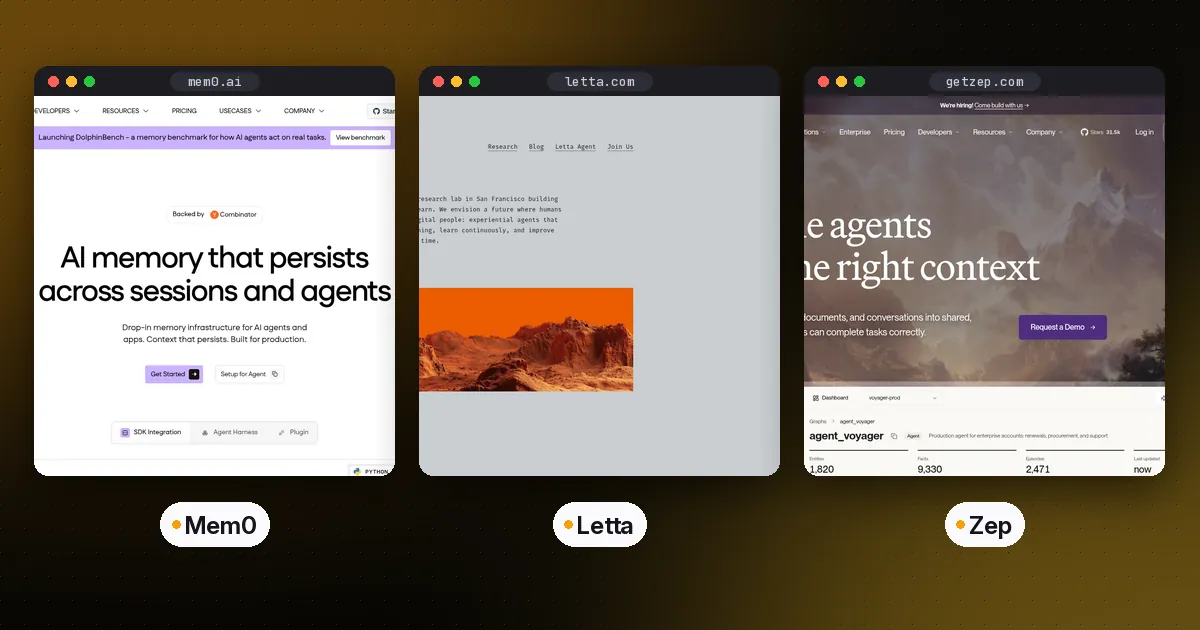
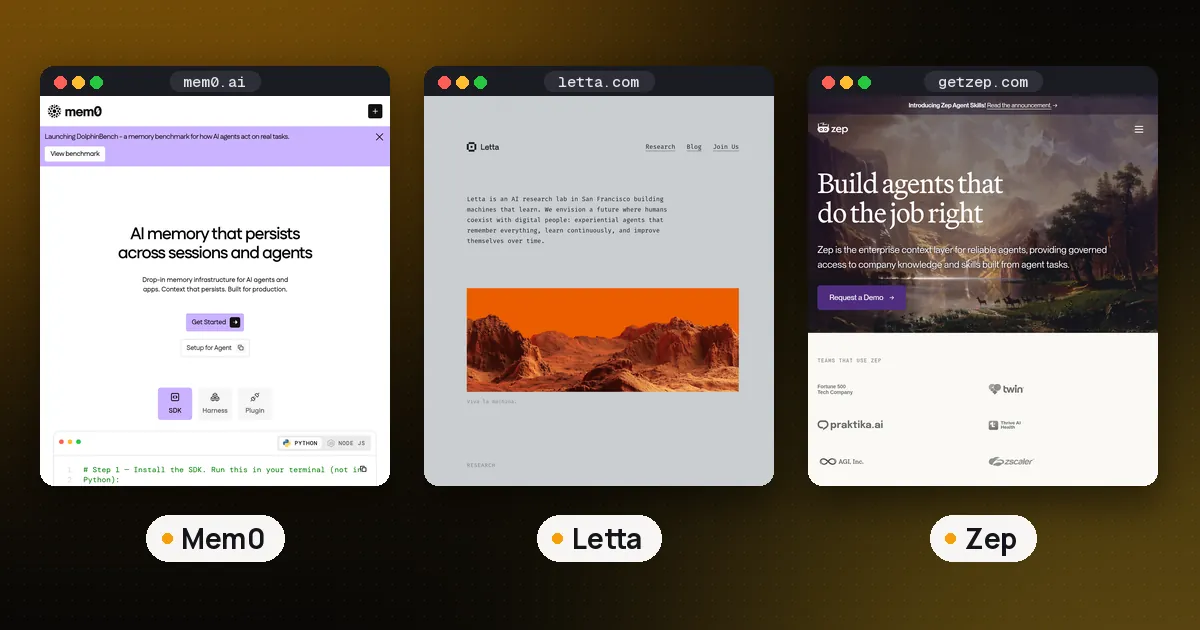
For how Mem0 compares with Letta and Zep outside Hermes, see our AI agent memory comparison.
How to set up a memory provider in Hermes Agent
- Check what you have:
hermes memory statusshows the built in stores, the active provider and the installed plugins. - Install a catalog provider, for example
hermes plugins install holographic. - Select it with
hermes memory setup, or set it directly withhermes config set memory.provider holographic. - Add a key if it needs one. Secrets go in the profile's
.envfile, such asMEM0_API_KEYfor Mem0 Platform. - Run
hermes memory statusagain. When we set RetainDB without a key, status showed "not available" and named the missingRETAINDB_API_KEY.
To go back to built in memory only, run hermes memory off. Each Hermes profile has its own home folder, so local providers keep separate databases and cloud providers keep separate credentials per profile.
One install note: the PyPI package named hermes-agent was still at 0.19.0 when we checked, and building the current source as a wheel stops with a message that Hermes is distributed through the shell installer, Docker image or Nix. Use one of those for a current version.
Which Hermes Agent memory provider should you pick?
- One developer, one machine, privacy matters: Holographic.
- You want memory with zero curation: Mem0, in Platform mode to start or OSS mode to keep it local.
- A shared bot or several profiles: Honcho.
- You need relationships and synthesis: Hindsight.
- Only a handful of facts: no provider, as long as they fit the 2,200 and 1,375 character caps.
If you also use Claude Code, compare how it handles the same problem in our explainer on agent memory in Claude Code. For agents built on Letta or Zep, memory is part of the platform rather than a plugin.
FAQ
Can Hermes Agent use two memory providers at once?
No. Only one external provider can be active at a time. The built in MEMORY.md and USER.md stay active beside it, and Hermes mirrors built in memory writes to the external provider.
Does Hermes Agent memory work offline?
Yes with the built in files and with Holographic in its default settings, which make no network or model calls. Mem0 in OSS mode with Ollama and a local Qdrant can also run without a cloud service.
Is Mem0 free for Hermes Agent?
Mem0 has a Free plan with monthly add and retrieval limits, and its OSS mode and self hosted server are free apart from the models and storage you run. The Hermes plugin itself is free to install.
Where does Hermes Agent store memory?
The built in files live in the memories folder of your Hermes home (by default under ~/.hermes), past sessions live in state.db, and Holographic writes memory_store.db in the same home. Each profile has its own folder.
What does a memory provider send to the cloud?
Hermes passes turns, transcripts, recall queries and mirrored memory writes to the provider, and it runs them through a secret scrub first so recognizable keys are masked. The docs warn that credentials with no recognizable shape are not detected.