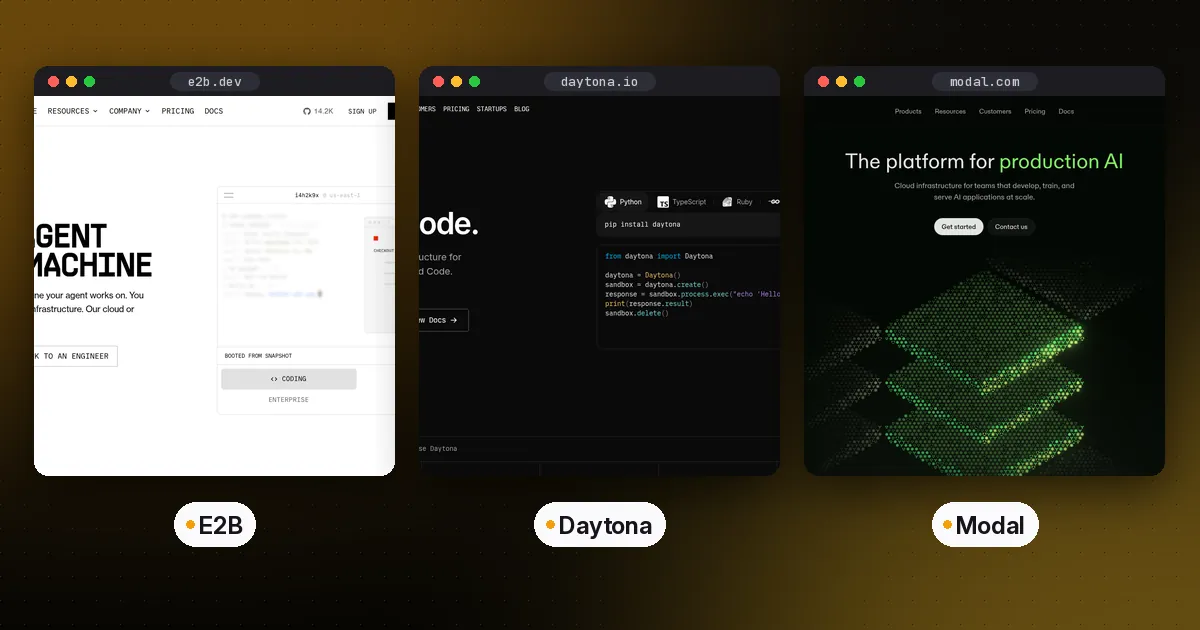
Is E2B sandbox free? Partly. The Hobby plan costs $0 a month, needs no credit card, and gives each new account a one time $100 in usage credits, so you can create a free API key and run real sandboxes until that credit is gone. After that, sandboxes are billed per second for the CPU and memory you provision, and the $150 a month Pro plan adds no credits at all. If you want sandboxes with no bill ever, the E2B runtime is open source under Apache 2.0 and you can host it yourself on a Linux machine with KVM.
E2B runs each sandbox as a Firecracker microVM that your agent can start from Python or JavaScript, run commands in, and pause or kill. This guide sticks to money and limits: what the free credit covers, how fast it runs out, what happens when it does, and how the free allowances of other sandbox services compare. For isolation, persistence and startup behavior, see our E2B vs Daytona vs Modal comparison.
Is E2B sandbox free on the Hobby plan?
The E2B pricing page and the billing and limits docs list three plans. We checked both on November 10, 2026.
| Plan | Monthly fee | Credits | Concurrent sandboxes | Longest continuous run | Disk |
|---|---|---|---|---|---|
| Hobby | $0 | $100, one time | 10 | 1 hour | 10 GiB |
| Pro | $150 plus usage | none | 100 (up to 1,100 with paid upgrades) | 24 hours | 20 GiB |
| Enterprise | custom, $3,000 monthly minimum | custom | 1,100 and up | custom | custom |
Hobby sandboxes can have up to 8 vCPUs and 8 GiB of memory. Hobby projects can create one sandbox per second, run 20 template builds at once and store 10 secrets. Disk is included on every plan with no separate charge, and paused sandboxes are kept with no expiry on all three.
So the honest answer is "free to start, not free forever." The $100 is a single grant per new account, not a monthly allowance. The docs say plainly that upgrading to Pro "does not grant additional credits," so moving up raises your limits but does not refill anything.
Is the E2B API key free?
Yes. Creating an account and an API key costs nothing, and E2B says no credit card is needed to start. You sign up in the E2B console, open the API Keys tab, and copy a key that starts with e2b_. Set it as E2B_API_KEY and the SDK picks it up.
What the key does not give you is free compute without limits. Every sandbox you create with it draws down the $100 credit. We tried the SDK without a key to see what a new user hits first. With e2b 2.63.0, Sandbox.create() with no key fails at once with an AuthenticationException that tells you to visit the API Keys tab. A made up key gets a 401 from the API saying the key is invalid and no team matches it. There is no anonymous or keyless mode for creating sandboxes, unlike some search APIs we have covered such as Tavily's keyless tier.
How far does the $100 E2B credit go?
E2B publishes two rates: $0.000014 per vCPU second and $0.0000045 per GiB of RAM per second. Disk is free. That works out to about $0.0504 per vCPU hour and $0.0162 per GiB hour. You pay for what you provision while the sandbox runs, not for how busy it is.
The default sandbox size is where the sources disagree. The pricing page says the default is 2 vCPUs and 4 GiB of RAM. The cost tips in the billing docs say to start with the default of 2 vCPUs and 512 MiB. Here is the math for both, plus the largest Hobby size:
| Sandbox size | Cost per hour | Hours from $100 |
|---|---|---|
| 2 vCPU, 512 MiB | about $0.109 | about 918 |
| 2 vCPU, 4 GiB | about $0.166 | about 604 |
| 8 vCPU, 8 GiB | about $0.533 | about 188 |
Those hours are total sandbox time across all your sandboxes, not wall clock time. If you keep all 10 Hobby slots busy around the clock with 2 vCPU, 4 GiB sandboxes, you spend about $1.66 an hour and the credit lasts roughly 60 hours. If your agent opens a sandbox for a two minute code run a few dozen times a day, the same credit can last many months.
The SDK helps here. In e2b 2.63.0 the default template is base and the default timeout is 300 seconds, so a sandbox you forget about is killed after five minutes unless you change the timeout or set it to pause instead.
What happens when the free credit runs out?
According to the billing FAQ, if you have no payment method on file when the credit hits zero, every project in your workspace is blocked shortly afterward. Adding a card unblocks them, and from then on E2B bills at the start of each month for the previous month's usage.
You can set a spending limit on the budget page of the dashboard, which is the main safety net once a card is attached. Watch the usage tab while you test, especially if your agent creates sandboxes in a loop.
How to stretch the E2B free tier
Most wasted credit comes from sandboxes that sit idle while still provisioned. These habits come straight from E2B's own cost advice and the persistence docs:
- Pause instead of leaving it running. Compute billing stops when a sandbox is paused, killed or timed out. A pause keeps the filesystem and memory, so you can resume later without paying for the gap.
- Make timeouts pause, not kill. Setting
on_timeoutto"pause"in the lifecycle options keeps state when the timer runs out. The default is"kill". - Kill what you are done with. Call
kill()at the end of a task rather than waiting for the timeout. - Right size your template. Ask for the vCPUs and RAM the job needs. Going from 4 GiB to 512 MiB at 2 vCPUs cuts the hourly cost by about a third.
- Keep the loop tight. If an agent you built yourself only needs to run a short script, create the sandbox, run it, and close it in the same step.
Can you run E2B free by self hosting?
Yes, if you have the hardware. The E2B runtime repository holds the whole backend (API, orchestrator, in VM agent, edge proxy and template builder) under the Apache 2.0 license. Its single machine package, E2B Embed, runs the stack on one Linux host with KVM using Docker Compose, and also ships as Terraform for Google Cloud, AWS and Azure and as a Kubernetes manifest. The SDK and API are the same as E2B Cloud, so code you wrote against the hosted service points at your own node.
Self hosting trades the bill for upkeep. You pay for the machine, keep it patched, and run Postgres, Redis, ClickHouse and object storage beside it. Embed is one node by design. For bigger production setups E2B points you to its enterprise offering. If what you really want is a governed local sandbox for a coding agent rather than an API for generated code, NVIDIA OpenShell is a different kind of tool worth a look.
E2B vs Vercel Sandbox and other free tiers
Several sandbox services give away some compute. They do it in different shapes, which matters more than the headline number. All figures below come from each vendor's pricing page on November 10, 2026.
| Service | Free allowance | Renews? | Notes |
|---|---|---|---|
| E2B Hobby | $100 credit | No, one time | 10 concurrent, 1 hour runs |
| Vercel Sandbox Hobby | 5 Active CPU hours, 420 GB hours of memory, 5,000 creations | Monthly | 10 concurrent, 45 minute sessions |
| Daytona | $200 in free compute | Not stated on the page | No credit card to start |
| Modal Starter | $30 of compute | Monthly | Sandboxes bill at 3x list price |
Vercel is the most different. It counts only active CPU time, so time spent waiting on a model call does not burn CPU hours, but memory counts the whole time the sandbox is up. When a Hobby account runs past its allowance, sandbox creation pauses until the cycle resets rather than sending a bill. That makes it the safest free option if a surprise charge is your worst case, while E2B's one time credit is larger up front but ends.
Daytona publishes the same per hour vCPU and memory rates as E2B ($0.0504 and $0.0162) and offers twice the starting credit. Modal refills $30 every month on its free plan, which suits steady light use, but its sandboxes run at the non preemptible rate of three times list price. Smaller players such as Lizard and Sandbox0 are covered in our comparison guide.
Which should you pick if cost is the main concern?
For a prototype or a weekend project, E2B's $100 credit is plenty, and you get the same SDK you would use in production. For a hobby app that will run every month with no budget, a renewing allowance (Vercel Sandbox or Modal) is the better fit, because E2B's credit will eventually run out. For a team that wants sandboxes with no vendor bill and has a spare Linux server, self hosting E2B Embed is the free path that keeps the same API.
Whatever you choose, set a budget or spending limit on day one and make idle sandboxes pause or die on their own. That single habit matters more than which free tier you start on.
FAQ
Is E2B free for open source projects?
E2B's pricing page does not list a special free plan for open source projects. Everyone starts on Hobby with the one time $100 credit. The runtime itself is open source under Apache 2.0, so open source maintainers who need ongoing free use can self host it.
Does E2B charge for paused sandboxes?
No compute is charged while a sandbox is paused, killed or timed out, according to the billing docs. Paused sandboxes are kept with no expiry on every plan, and disk is included at no extra cost.
Do I need a credit card for E2B?
Not to start. The Hobby plan needs no card, and you can create an API key and spend the $100 credit without one. You need a payment method once the credit runs out, or your projects get blocked.
Does the Pro plan include free credits?
No. Pro costs $150 a month plus usage and adds no credits. It raises limits: 100 concurrent sandboxes, 24 hour continuous runs, 20 GiB of disk and custom CPU and memory sizes.
Can E2B sandboxes use a GPU?
No. E2B's pricing page says its sandboxes are CPU only. If an agent needs a GPU, Daytona and Modal both list GPU pricing.