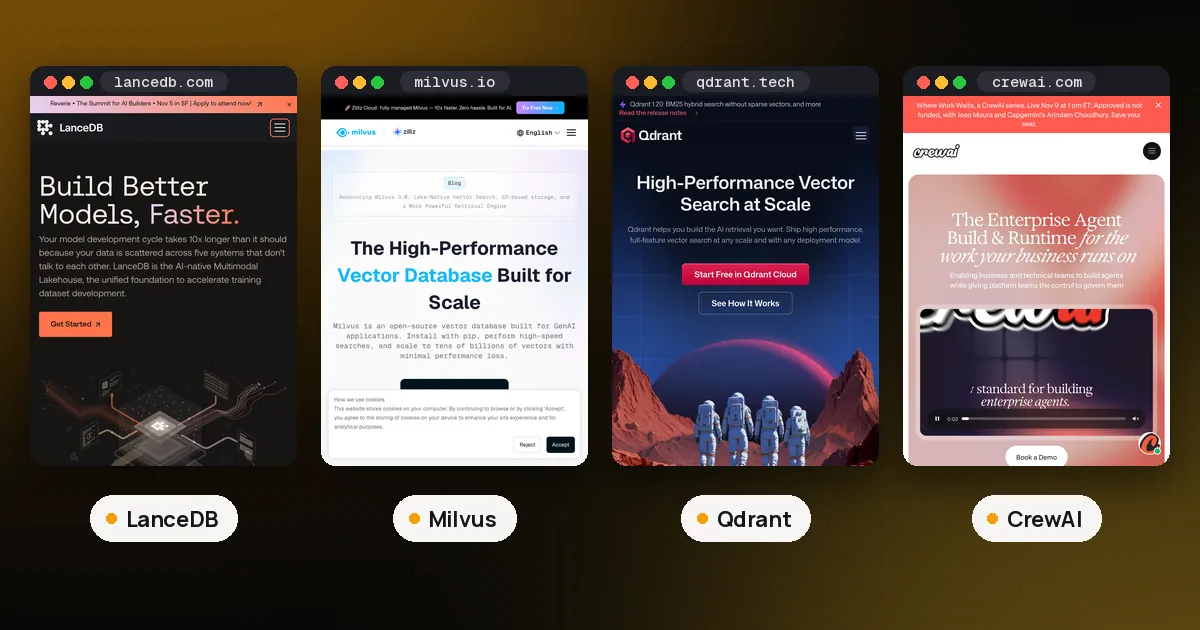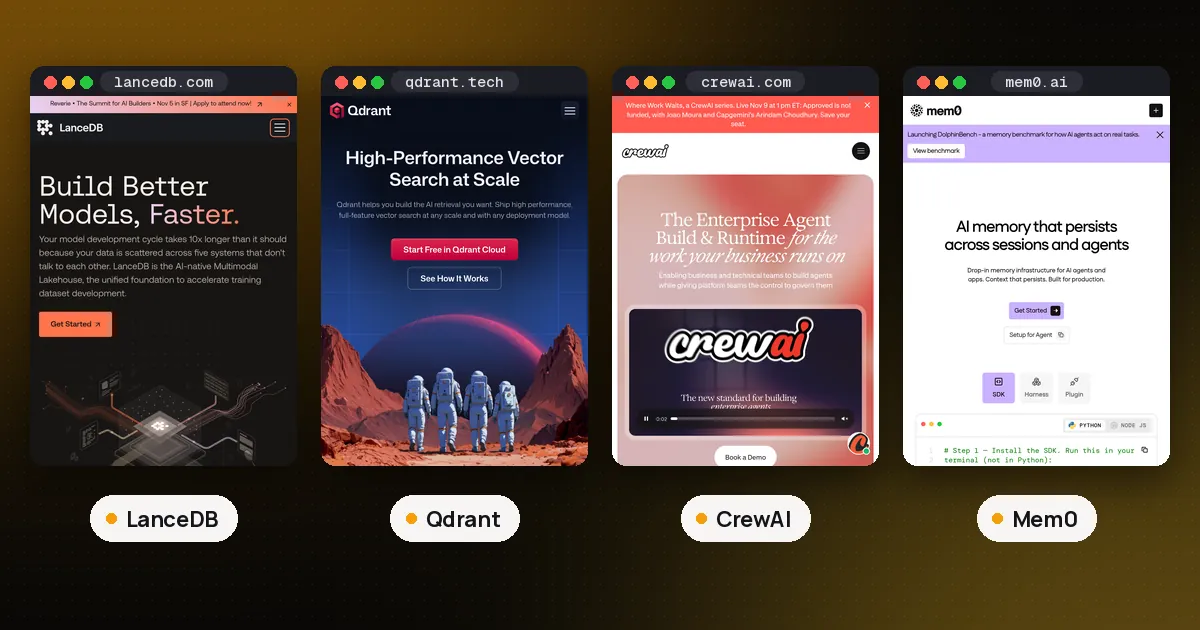
LanceDB vs Qdrant comes down to one question: do you want the database inside your agent's process or next to it? Pick LanceDB when one app or one agent owns its data and you want a folder (or an S3 bucket) instead of a server. Pick Qdrant when several processes, users or services read and write the same memory at once and you want a network API with per tenant filtering, API keys and a managed cloud option. Both are open source under Apache 2.0, both are written in Rust, and both do vector, keyword and hybrid search, so the choice is about architecture, not features on a checklist. Other engines such as Weaviate and Chroma are listed in our vector databases directory. If neither fits, our best open source vector database guide compares the other main options.
We checked both against their official docs on October 21, 2026 and ran the code below on the box with lancedb 0.40.0 (released October 7, 2026) and qdrant-client 1.19.1 against Qdrant's local mode. The latest Qdrant server release was v1.19.2 (October 5, 2026). Both Python packages need Python 3.10 or newer.
LanceDB vs Qdrant at a glance
| Item | LanceDB | Qdrant |
|---|---|---|
| Shape | Embedded library, runs in your process | Server (Docker, binary or cloud) with REST and gRPC |
| Storage | Lance files on local disk or object storage (S3, GCS, Azure Blob) | Its own storage on the server's disk |
| Clients | Python, TypeScript, Rust | Python, TypeScript, Rust, Go, Java, .NET and more |
| Keyword search | Built in BM25 full text index | Sparse vectors with a BM25 model and IDF modifier |
| Hybrid search | query_type="hybrid", RRF reranker by default | Prefetch plus fusion in the Query API |
| Filtering | SQL style where clauses | Payload filters with payload indexes |
| Versions | Every write makes a table version you can check out | Snapshots for backup and restore |
| Hosted option | LanceDB Enterprise (private cloud or BYOC, contact sales) | Qdrant Cloud with a free tier, plus hybrid and private cloud |
| License | Apache 2.0 | Apache 2.0 |
The rest of this guide explains what those rows mean when the user of the database is an AI agent.
What LanceDB is
LanceDB describes itself as a multimodal lakehouse for AI. Its open source edition is an embedded retrieval library: you pip install lancedb, call lancedb.connect("./agent_memory"), and the database is a directory of Lance files. Lance is the columnar file format underneath, designed for fast random access, so text, metadata, vectors and even images can sit in one table.
Three traits matter most for agent builders:
- No server. The quickstart connects to a local path, an
s3://,gs://oraz://URI, or adb://URI for Enterprise. Nothing to deploy for a prototype or a desktop agent. - Storage you choose. The storage docs rank backends from object storage (lowest cost, hundreds of milliseconds of latency) to local NVMe (fastest, p95 often under 10 ms). Because LanceDB separates storage and compute, stateless workers can share one bucket.
- Versioned tables. Each write creates a new table version. You can list versions,
checkoutan older one andrestoreit, which is useful when a bad batch of agent memories needs rolling back.
Its OSS FAQ says LanceDB OSS "can comfortably handle millions of vectors on a single node" and points users who need hundreds of millions of vectors toward Enterprise. It also says you often don't need a vector index at all below about 100,000 records, since brute force search is fast enough there. If you expect to outgrow one node, compare LanceDB vs Milvus.
Agent frameworks already ship it. CrewAI's memory docs list LanceDB as the default storage backend, stored under ./.crewai/memory. If you use CrewAI with memory on, you are already running LanceDB.
What Qdrant is
Qdrant is a vector search engine you run as a service. The quickstart starts the qdrant/qdrant Docker image, which serves REST on port 6333 and gRPC on port 6334, and clients talk to it over the network. The Python client also has a local mode (QdrantClient(path="./db")) for tests and prototypes.
What it gives agents:
- Shared access. Many workers, agents and services can query one collection at the same time, because the server owns concurrency.
- Tenant aware filtering. A payload field such as
user_idcan be indexed withis_tenant=True, and the multitenancy guide recommends one collection with a tenant field over one collection per user. - Hybrid queries. The hybrid queries docs show dense and sparse vectors on the same point, combined with prefetch and fusion.
- An official MCP server. mcp-server-qdrant exposes store and find tools so Claude Code, Cursor or any MCP client can use a collection as memory.
Qdrant's own security docs warn that a self hosted instance has no authentication by default. Set an API key before you expose it anywhere. Mem0, which we compare in our AI agent memory guide, uses a local Qdrant store by default, so Mem0 users are often running Qdrant without having chosen it.
Same agent memory in both, side by side
Here is the same job in each: store a few memories for two users, then fetch only Ana's memories for a question. The embed() function is a stand in; swap in any real embedding model with a fixed vector size.
LanceDB:
import lancedb
from lancedb.index import FTS

db = lancedb.connect("./agent_memory")
rows = [{**m, "vector": embed(m["text"])} for m in memories]
tbl = db.create_table("memories", data=rows, mode="overwrite")
tbl.create_index("text", config=FTS(), replace=True)

hits = (tbl.search(query_type="hybrid")
          .vector(embed("how does this user deploy"))
          .text("Hetzner")
          .where("user_id = 'ana'", prefilter=True)
          .limit(3)
          .to_list())
Qdrant:
from qdrant_client import QdrantClient, models

client = QdrantClient(url="http://localhost:6333")
client.create_collection("memories",
    vectors_config=models.VectorParams(size=DIM, distance=models.Distance.COSINE))
client.upsert("memories", points=[
    models.PointStruct(id=str(uuid.uuid4()), vector=embed(m["text"]), payload=m)
    for m in memories])

hits = client.query_points("memories",
    query=embed("how does this user deploy"),
    query_filter=models.Filter(must=[
        models.FieldCondition(key="user_id", match=models.MatchValue(value="ana"))]),
    limit=3).points
Both returned only Ana's two memories in our run. Two things we hit while testing: in lancedb 0.40.0 the older create_fts_index() call still works but prints a deprecation warning (it was deprecated in 0.25.0), so use create_index() with FTS(). And in LanceDB the hybrid query takes the vector and the text separately, which makes it easy to search meaning with the full question and keywords with just the rare term. For a fuller Qdrant walkthrough with payload indexes and BM25 sparse vectors, see how to use Qdrant vector database.
Where each one breaks down
Many writers at once
This is the biggest practical difference. LanceDB's FAQ says it handles concurrent reads well and supports concurrent writes, "though too many concurrent writers can lead to failing writes" because a writer retries its commit a limited number of times. It also warns against Python's fork start method, since Lance is multithreaded inside. And by default a connection doesn't check for other processes' writes on its own: you set read_consistency_interval (zero means check on every read) when one agent must see what another just wrote.
Qdrant was built for that case. A fleet of agents writing memories into one collection is ordinary server traffic.
Running with no infrastructure
Here LanceDB wins. A coding agent on a laptop, a CLI tool, a notebook or a serverless function can keep its memory in a folder or a bucket. Qdrant's local mode exists, but the client warned us in testing that payload indexes have no effect in that mode, so it is a testing tool rather than a production embedded store.
Big multimodal data
If your agent works over images, video frames or large documents and you also want to train or evaluate on the same data, LanceDB's lakehouse design keeps the raw bytes, features and vectors in one versioned table. Qdrant stores vectors plus a JSON payload; the source files usually live elsewhere.
Managed hosting and price
Qdrant publishes its pricing: a free cluster forever with 0.5 vCPU, 1 GB of RAM and 4 GB of disk, then a Standard tier billed hourly by resource use, and a Premium tier with SSO and private VPC links that has a minimum spend. LanceDB's current docs describe two editions, OSS and Enterprise, with Enterprise set up through its sales team for private cloud or bring your own cloud deployments, and no public price list. If you want a hosted endpoint you can sign up for today with a card, that points to Qdrant.
Which should you use?
- A single agent, desktop app or coding tool: LanceDB. No server to run, and memory travels with the project folder.
- CrewAI with memory on: keep LanceDB unless you outgrow it; it's the default.
- A multiuser product where every user's memories share one store: Qdrant, with a tenant indexed
user_id. - Many agents writing at the same time: Qdrant.
- Agents that need MCP access to a vector store out of the box: Qdrant, through its official MCP server. You can also wrap either one yourself by following our MCP server in Python guide.
- Multimodal data you also train on: LanceDB.
If neither fits, Chroma is another embedded option and Milvus and Weaviate are other server options; Weaviate also has an MCP endpoint built into the server. For how retrieval fits into a full agent, see how to build a RAG pipeline with LangGraph.
FAQ
Is LanceDB faster than Qdrant?
There is no neutral answer, and we haven't benchmarked them against each other. Speed depends on the storage backend (LanceDB on S3 is slower than on local NVMe, by its own docs), the index type, filters and concurrency. Test with your own data and query pattern.
Can LanceDB run as a server?
Not in the open source edition, which is an embedded library. Teams that need a shared service either put their own API in front of it or use LanceDB Enterprise, which serves remote tables through db:// connections.
Can Qdrant run embedded without a server?
The Python client's local mode runs the API in process with QdrantClient(":memory:") or a path on disk. It's meant for prototypes, tests and CI; for production, run the server.
Do both support hybrid search?
Yes. LanceDB combines a vector search with its BM25 full text index and merges them with a Reciprocal Rank Fusion reranker by default. Qdrant stores a dense and a sparse vector on each point and fuses the results in one Query API call.
Which is cheaper?
For self hosting, both are free and open source. LanceDB on object storage avoids paying for an always on server. Qdrant Cloud has a free tier and published usage billing; LanceDB Enterprise is priced by quote.