Is Tavily API free? Yes. You can use the Tavily API free in three ways: call Search and Extract with no key at all in keyless mode, sign up for a free API key that gives you 1,000 credits every month with no credit card, or, if you are a student, ask for four months of the Project plan at no cost. The free key covers every endpoint, while keyless mode covers only Search and Extract and has its own rate limit. You pay only when an agent needs more than 1,000 credits a month, starting at $0.008 a credit.
That answer holds for most hobby projects and prototypes. The catch is that credits go fast once an agent runs advanced searches, crawls or research tasks in a loop, so it helps to know what each call costs before you wire Tavily into a tool loop. Every price and limit below comes from Tavily's pricing page, its credits documentation and its rate limits page, all checked on October 30, 2026.
Three ways to use the Tavily API free
| Route | What you need | What it covers | Limit |
|---|---|---|---|
| Keyless mode | Nothing, just a request header | Search and Extract only | Rate limited, exact cap not published |
| Free API key (Researcher plan) | A free account, no card | All endpoints | 1,000 credits a month |
| Student plan | Proof of student status | All endpoints | 4,000 credits a month for 4 months |
Keyless mode is the newest route. Tavily's keyless documentation says you can send a request to Search or Extract with the header X-Tavily-Access-Mode: keyless and no account at all, and the response uses the same schema as a keyed one. Crawl, Map and Research still need a key.
The free API key sits on what Tavily calls the Researcher plan. You sign up, copy the key from the dashboard, and get 1,000 API credits a month. Tavily says no credit card is required.
The student plan is handled by support. According to the Tavily help center, students who email support from a school address or share a student ID get a coupon for four months of the Project plan, which includes 4,000 credits a month.
Is the Tavily API key free?
Yes, the key itself costs nothing. What you can do with it depends on the key type. Tavily issues two environments: a Development key allows 100 requests per minute, and a Production key allows 1,000. Production keys need an active paid plan or pay as you go billing turned on, so a free account works with Development keys only. For a prototype or a personal agent, 100 requests a minute is rarely the bottleneck; the monthly credit budget runs out first.
Crawl has its own cap of 100 requests per minute on both key types, and Research is capped at 20 new tasks per minute.
What each call costs in credits
Credits are the unit for everything, so the real question is how many calls your agent makes and at what depth. Here are the rates from the credits documentation:
| Endpoint | Cost |
|---|---|
Search, basic, fast or ultra-fast depth | 1 credit per request |
Search, advanced depth | 2 credits per request |
| Extract, basic | 1 credit per 5 successful URLs |
| Extract, advanced | 2 credits per 5 successful URLs |
| Map | 1 credit per 10 pages (2 with natural language instructions) |
| Crawl | Map cost plus Extract cost |
Research, mini model | 4 to 110 credits per request |
Research, pro model | 15 to 250 credits per request |
Failed URL extractions and failed map requests are not charged. One setting to watch: the search reference says that turning on auto_parameters can switch a query to advanced depth, which costs 2 credits. Set search_depth to basic yourself if you want to keep every search at 1 credit.
In our keyless test, the usage field matched these rates for search: basic and fast queries came back with 1 credit, and an advanced query came back with 2. An extract of two URLs came back with 0 credits, which fits the rule of 1 credit per five successful URLs.
How far 1,000 free credits go
Some plain arithmetic from the published rates, using a free key:
- 1,000 basic searches, or 500 advanced ones.
- About 5,000 successful URL extractions at basic depth.
- Roughly 330 small crawls of 10 pages each at basic depth (Tavily's own example puts that crawl at 3 credits).
- As few as 4 Research requests on the
promodel if each one hits the 250 credit ceiling.
A typical research agent that runs three basic searches and extracts five pages per task spends 4 credits a task, which gives you about 250 tasks a month for free. Switch those searches to advanced and the same task costs 7 credits, or about 140 tasks. The Research endpoint is the one that drains a free account fastest, because a single deep report can use a quarter of the month.
Credits reset on the first day of each month, whatever day you signed up, and unused credits do not appear to carry over (the pricing FAQ describes a clean slate each month).
What happens when the free credits run out
Tavily's pricing FAQ says that when you use up your monthly credits, requests stop until the credits reset or you upgrade. Nothing is billed by surprise on the free plan. The search reference lists the error codes your agent should handle:
429means you hit a rate limit. Wait for the number of seconds in theRetry-Afterheader.432means a key limit or plan limit was exceeded.433means you passed the pay as you go spending limit you set in the dashboard.434is specific to free plans: requests that setmax_age_hoursto force fresh page fetches can be refused under heavy load. Leavingmax_age_hoursunset lets Tavily serve cached copies instead.
In keyless mode the limit message is written for an agent to read. When we called Crawl without a key, the API answered with a 404 and a JSON body explaining that keyless access supports only Search and Extract, with two suggested next steps: sign up for a key, or pay for the request with x402.
How to try Tavily without signing up
The Python SDK switches to keyless mode on its own when you create a client with no key and no TAVILY_API_KEY environment variable. This is what we ran:
from tavily import TavilyClient

client = TavilyClient()  # no key: keyless mode
result = client.search(
    "Model Context Protocol specification latest version",
    search_depth="basic",
    max_results=3,
    include_usage=True,
)
print(result["usage"])  # {'credits': 1}
for item in result["results"]:
    print(item["title"], item["url"])
Calling client.crawl() the same way raises KeylessUnsupportedEndpointError, which tells you to pass a key. When you are ready for more, set TAVILY_API_KEY to your free key and the same code runs against your account. The keyless docs also say that if a request carries both the keyless header and a valid key, the key wins and your account limits apply.
For coding agents, Tavily's remote MCP server accepts the same header. In Claude Code the docs give claude mcp add tavily --transport http https://mcp.tavily.com/mcp/ --header "X-Tavily-Access-Mode: keyless", which adds search and extract tools with no account. Without the header, the server asks your client to sign in. For the full picture of tools, credits and client setup, see whether Tavily MCP is free. Our guide to running MCP servers locally covers how to test a server like this before you rely on it.
How to stay inside the free tier
- Default to basic depth. Advanced search doubles the cost. Save it for queries where the first pass came back thin.
- Ask for usage on every call. Set
include_usageto true and log the credits per task, so you see the burn rate early. - Check the meter. With a key, the
GET /usageendpoint returns credits used against your limit, split by endpoint. It is limited to 10 calls per 10 minutes, so poll it once per run, not once per call. - Cap max results. Fewer results do not cost fewer credits, but they mean less text in your model's context, which saves on the model side.
- Cache repeat queries. Agents ask the same question more often than you would expect. A simple dictionary cache keyed on the query string saves real credits.
- Keep Research for the end. Use plain Search and Extract in the agent loop and call Research only when you truly need a full report.
If you are building the loop yourself, our guide to building an AI agent from scratch shows where a search tool fits and how to cap steps, which also caps credits. If you use LangChain, the official integration package is langchain-tavily (0.2.18 on PyPI as of today), listed with the rest of the framework on our LangChain page. Our step by step guide on how to use Tavily in LangChain shows how to pin search depth so an agent cannot double your credit spend.
Paid plans if you outgrow the free tier
Pay as you go costs $0.008 per credit once your plan's credits run out. Monthly plans cost less per credit: Project is $30 for 4,000 credits, Bootstrap $100 for 15,000, Startup $220 for 38,000 and Growth $500 for 100,000, which works out to $0.005 a credit at the top tier. Enterprise pricing is custom.
Tavily is now part of Nebius, which announced the acquisition on February 10, 2026. Tavily's own announcement said the API and its data policies would stay the same, and the free plan is still listed today.
Free Tavily alternatives
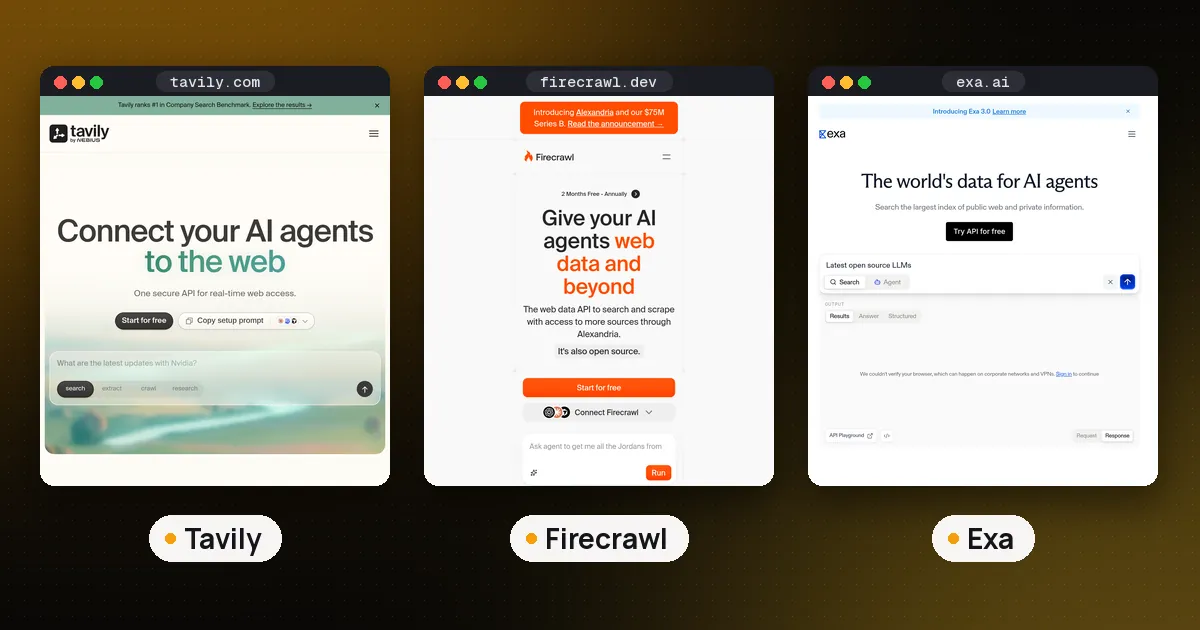
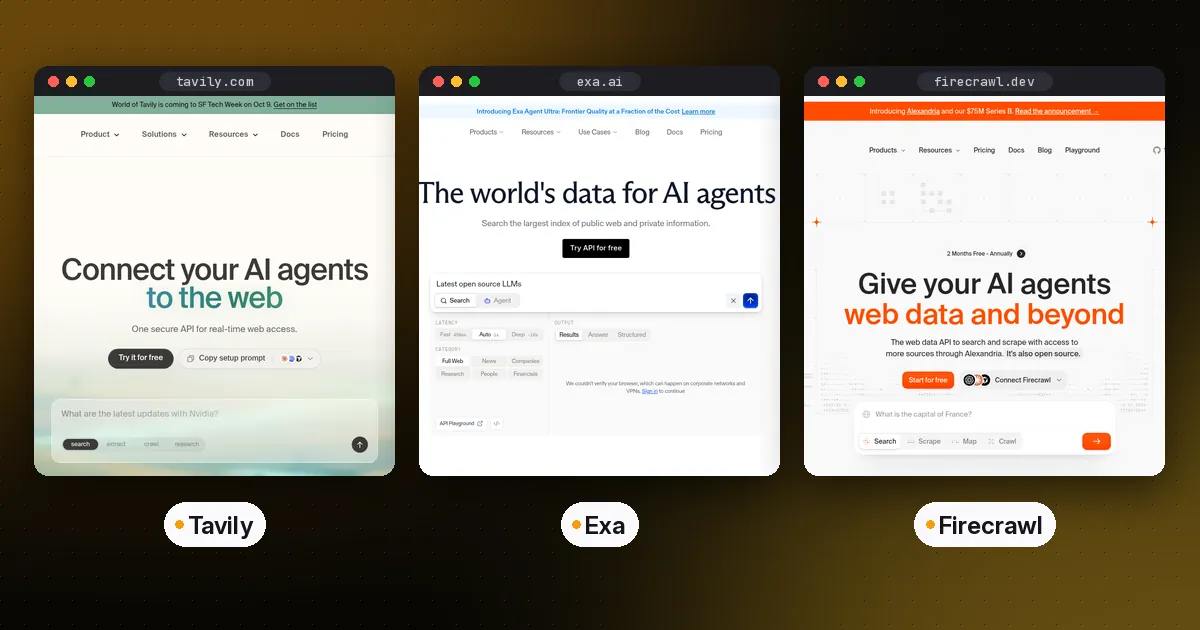
Two other agent web APIs we list also have free tiers, checked on their pricing pages today. Exa gives $10 of credits every month plus a $10 bonus when you sign up, with no payment method. Firecrawl has a free plan with 1,000 credits a month, which it describes as 500 searches or 1,000 scraped pages, plus a self hostable open source core. For how the three compare on search quality and page reading, see Tavily vs Exa vs Firecrawl. When free credits are not enough and you want to run search on your own servers, see self hosted Tavily alternatives. If your agent needs to click and log in rather than read, look at Browser Use vs Stagehand vs Playwright MCP instead.
Our pick: start keyless to see whether Tavily's results suit your agent, move to the free key as soon as you need Crawl or want a predictable budget, and pay only when your logs show you passing 1,000 credits a month. More on the product itself is on our Tavily page.
FAQ
Is Tavily search API free?
Yes. A free account gets 1,000 credits a month, and a basic search costs 1 credit, so that is up to 1,000 searches. You can also search with no key in keyless mode, which is rate limited.
Do I need a credit card for a Tavily API key?
No. Tavily says the free plan needs no credit card. You only add a payment method to upgrade or to turn on pay as you go.
Do unused Tavily credits roll over?
Tavily's pricing FAQ says credits reset on the first day of each month and describes each month as a clean slate, so plan as if unused free credits do not carry over.
Can I use Tavily in production on the free plan?
Free accounts get Development keys at 100 requests per minute. Production keys, at 1,000 requests per minute, need a paid plan or pay as you go. A small production app can run on a Development key if 1,000 credits a month covers it, but you have no headroom if traffic spikes.
Does Tavily keyless mode support crawl or research?
No. Keyless mode supports Search and Extract only. Crawl, Map and Research need an API key, and the free key works for all of them.
Is Tavily free for students?
Yes. Verified students can get four months of the Project plan, with 4,000 credits a month, by contacting Tavily support from a school email address or with a student ID.