Is Tavily MCP free? Yes, because MCP is a way to connect to Tavily, not a second paid product. The official tavily-mcp package is MIT licensed, and Tavily hosts a remote server at https://mcp.tavily.com/mcp/ that you can add to Claude Code, Cursor, VS Code, ChatGPT, Codex or any MCP client with no separate MCP charge. Search and extract work with no account, using Tavily's keyless mode. A free Researcher key, which needs no credit card, gives you 1,000 credits a month and opens all five tools: search, extract, crawl, map and research. Those credits are the same ones the REST API uses, so you pay only when you go past the free budget.
Prices and limits below come from Tavily's MCP documentation, its keyless documentation, its credits page and its pricing page, all checked on November 7, 2026.
What Tavily MCP actually is
The Model Context Protocol is an open standard for giving an AI app tools. Tavily's MCP server wraps the Search, Extract, Crawl, Map and Research endpoints that the HTTP API already exposes, and presents them as tools a model can call by name. You point a client at the server instead of writing a custom plugin for each app. If the protocol itself is new, start with our what is MCP explainer and come back.
Tavily ships the connector in two forms:
- A hosted remote server at
https://mcp.tavily.com/mcp/. Clients connect over Streamable HTTP and authenticate with OAuth, an API key, or the keyless header. - A local package on npm named
tavily-mcp. Your client starts it withnpx, usually over stdio. The latest version on npm on November 7, 2026 was 0.2.22, published under the MIT license according to both the npm listing and the GitHub repository. Tavily's docs say you need Node.js 20 or newer.
The two are not the same build. Local tavily-mcp@0.2.22 reported version 0.2.22. The hosted URL, reached with a keyless header, reported version 4.1.5. Tool names matched on both.
Claude Code also has a Tavily plugin that installs skills through a CLI. That path is separate from MCP.
The five tools your agent gets
On both the local 0.2.22 package and the remote 4.1.5 server, tools/list returned these names, with underscores rather than hyphens:
| Tool | What it does | Works in keyless mode? |
|---|---|---|
tavily_search | Search the web and return snippets plus source URLs | Yes |
tavily_extract | Pull page content from one or more URLs | Yes |
tavily_crawl | Walk a site from a starting URL and extract pages | No, needs a key |
tavily_map | Discover URLs under a starting page | No, needs a key |
tavily_research | Run multi source research and return a detailed answer | No, needs a key |
Tavily's MCP docs table uses the same underscore names. The keyless page writes hyphenated names such as tavily-search. Trust the names the server lists.
In our local keyless run, search and extract both returned live results. A search for current Model Context Protocol specification pages came back with several sources, including the 2026-07-28 specification post. An extract of Tavily's own MCP docs page returned the page text. Crawl, map and research did not fail as protocol errors. Each returned a plain text result that said the endpoint requires an API key, that keyless Tavily currently supports Search and Extract only, and that you can retry with those tools or sign up at tavily.com. The same message mentioned agentic payment with x402 as another option. The research tool's description notes a rate limit of 20 requests a minute, which matches Tavily's rate limits page.
Is Tavily MCP free? Three ways to connect
| Route | What you need | Tools you can call | Limit |
|---|---|---|---|
| Keyless mode | The header X-Tavily-Access-Mode: keyless, and no account | Search and extract | Rate limited; Tavily does not publish the exact cap |
| Free API key or OAuth (Researcher plan) | A free Tavily account, no credit card | All five tools | 1,000 credits a month |
| Student plan | Proof of student status sent to Tavily support | All five tools | 4,000 credits a month for 4 months |
Keyless mode is the fastest way to try the server. Tavily's keyless documentation says you can connect the remote MCP endpoint with that header and get search and extract with zero setup. The header is required. Without it, the server asks a capable client to sign in. Our raw SDK client, which has no OAuth browser flow, got MCP error -32603 ("Server returned an error response") when we omitted the header. Clients that only accept a URL and cannot send headers cannot use keyless mode; Tavily says to use an API key with those.
A free Researcher key, or an OAuth sign in that uses one, is the next step. Tavily's pricing page still lists the Researcher plan as free, with 1,000 API credits a month and no credit card. Signing in through OAuth does not create a second credit pool. The MCP docs say each connection asks whether to use your personal account or an organization, and that requests use the account's mcp_auth_default key (Tavily creates that key if it is missing). If you lose access to the account or the key is deleted, requests fail and you have to reconnect.
The student plan is handled by support. According to the Tavily help center, students who email support from a school address or share a student ID get a coupon for four months of the Project plan, which includes 4,000 credits a month.
The local npm package is free software. Running it on your laptop does not bypass the meter. With no TAVILY_API_KEY set, the 0.2.22 process printed that it was running in keyless mode, with search and extract available and other tools set to explain that a key is required. That matched what we saw when we called them. Set a free key in the environment and the same process spends that key's credits.
For credit math, error codes and keyless API calls outside MCP, see whether the Tavily API is free. MCP does not change those rules. It only changes how the agent discovers the tools.
What each MCP tool costs
Tavily does not publish a separate MCP price list. Each tool call is a Tavily API request, so the credits documentation applies:
| Tool | Matching endpoint | Credit cost |
|---|---|---|
tavily_search | Search | 1 credit at basic depth, 2 at advanced |
tavily_extract | Extract | 1 credit per 5 successful URLs at basic depth, 2 per 5 at advanced |
tavily_map | Map | 1 credit per 10 pages, or 2 per 10 when you send natural language instructions |
tavily_crawl | Crawl | Map cost plus extract cost (Tavily's example of 10 pages at basic depth is 3 credits) |
tavily_research | Research | 4 to 110 credits per request on mini, 15 to 250 on pro |
Failed URL extractions and failed map requests are not charged. The expensive habit with MCP is the same as with the API: letting the model call tavily_research inside a loop, or leaving search depth on advanced for every query. One pro research report at the 250 credit ceiling uses a quarter of a free month.
Credits reset on the first day of each month, whatever day you signed up. Tavily's pricing FAQ describes each month as a clean slate, so plan as if unused free credits do not carry over. When a free account uses up its monthly credits, requests stop until the credits reset or you upgrade. Nothing is billed by surprise on the free plan.
Rate limits follow the key, not the transport. Development keys allow 100 requests a minute. Production keys allow 1,000, and they need a paid plan or pay as you go billing. Crawl is capped at 100 requests a minute on both key types. Research is capped at 20 new tasks a minute. Keyless access has its own unpublished limit.
How to connect without paying
Tavily's documented Claude Code command for keyless access is:
claude mcp add tavily --transport http https://mcp.tavily.com/mcp/ \
  --header "X-Tavily-Access-Mode: keyless"
The Claude integration page shows the same header, next to an Authorization: Bearer YOUR_TAVILY_API_KEY option if you want to skip OAuth and use a key.
We used the MCP Python SDK 2.3.0 against that URL with only the keyless header. The server named itself tavily-mcp version 4.1.5, listed the five tools above, and a basic tavily_search for "Tavily MCP server documentation" returned two results.
If you already have a free Tavily account, add the remote server without putting a key in the URL:
claude mcp add tavily --transport http https://mcp.tavily.com/mcp/Start a new session, run /mcp, select tavily, and sign in. Cursor can use the same URL in ~/.cursor/mcp.json. VS Code accepts code --add-mcp '{"name":"tavily","type":"http","url":"https://mcp.tavily.com/mcp/"}'. Codex uses codex mcp add tavily --url https://mcp.tavily.com/mcp/ followed by codex mcp login tavily. After you sign in, usage lands on the mcp_auth_default key, which on a free account is the 1,000 credit Researcher budget.
To run the package yourself:
npx -y tavily-mcp@latestOr, scoped for Claude Code:
claude mcp add --scope user tavily-local -e TAVILY_API_KEY=YOUR_TAVILY_API_KEY -- npx -y tavily-mcp@latestA Claude Desktop block puts the key in the environment:
{
  "mcpServers": {
    "tavily-mcp": {
      "command": "npx",
      "args": ["-y", "tavily-mcp@latest"],
      "env": {
        "TAVILY_API_KEY": "tvly-YOUR_API_KEY-here"
      }
    }
  }
}
Omit TAVILY_API_KEY and, as of 0.2.22, the process starts in keyless mode instead of refusing to launch. For npx servers, Inspector checks and client config files, see how to run an MCP server locally.
You can pin default search behavior with a DEFAULT_PARAMETERS header on the remote server, or the same name as an environment variable on the local one. Tavily's example includes search_depth and max_results. We did not verify that rewrite ourselves. Set search_depth to basic if you want every search to stay at 1 credit.
Tavily also documents https://mcp.tavily.com/mcp/?tavilyApiKey=YOUR_API_KEY as an authentication option. A key in a query string is easy to leak through shell history, shared config files and logs. Prefer OAuth, the Authorization header, or TAVILY_API_KEY in the local process environment.
How to stay inside the free budget
Default to basic search, because advanced search doubles the credit cost. Treat tavily_research as a finale rather than something the model calls inside a loop: a single pro report can spend 15 to 250 credits. If your client supports DEFAULT_PARAMETERS, pin search_depth to basic. Fewer results do not reduce the search credit, but they do shrink what the model has to read. Cache repeat queries, because agents ask the same question more often than people do. Once you have a key, the API's GET /usage endpoint reports credits used against your limit. It is limited to 10 calls per 10 minutes, so poll it once per run.
If you use LangChain instead of MCP, langchain-tavily requires a key even though Tavily MCP accepts some keyless calls. See how to use Tavily in LangChain.
Web pages returned by search and extract can contain instructions aimed at the model. Treat tool output as untrusted input. Our MCP explainer covers those risks.
When you would pay, and what else to consider
You start paying when an agent needs more than 1,000 credits in a month (or 4,000 if you are on the student coupon). Pay as you go is $0.008 per credit once your plan's credits run out. Monthly plans cost less per credit: Project is $30 for 4,000 credits, Bootstrap $100 for 15,000, Startup $220 for 38,000 and Growth $500 for 100,000, which is $0.005 a credit at the top tier. Enterprise pricing is custom. Those figures are from the credits documentation, checked on November 7, 2026.
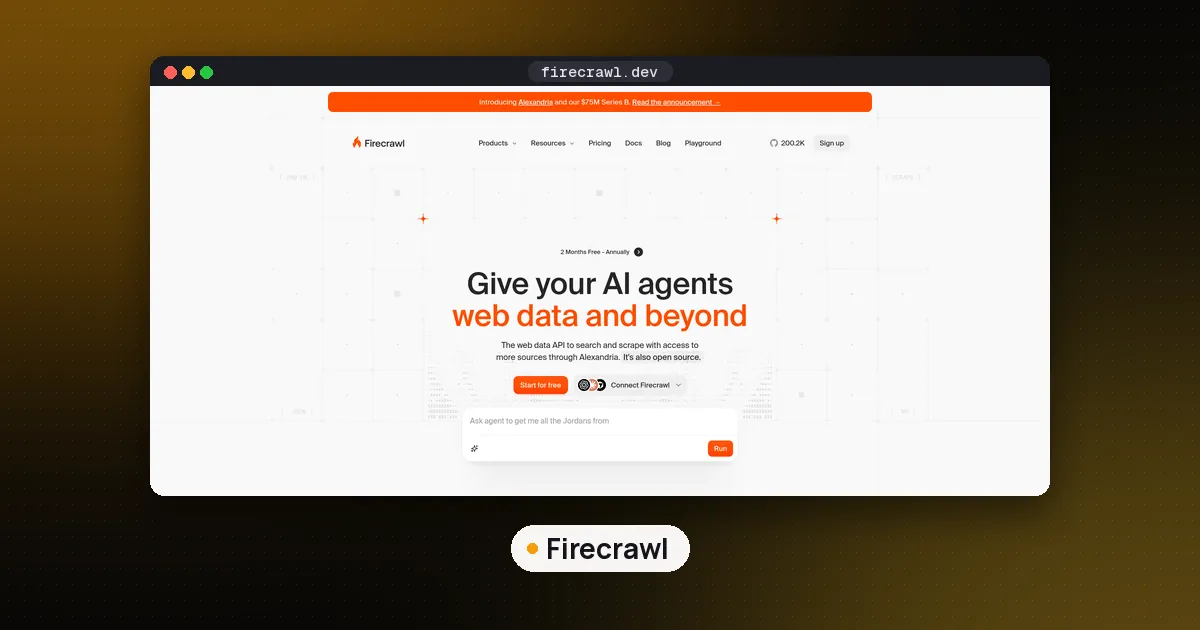
If the goal is to leave Tavily's hosted index, look at self hosted Tavily alternatives. Siftdog exposes search, extract, crawl and map over MCP, but you then run the search backend yourself. For a comparison of hosted Tavily with Exa and Firecrawl, including the fact that all three offer hosted MCP servers, see Tavily vs Exa vs Firecrawl. If you pick Firecrawl, our guide on how to use Firecrawl MCP covers its keyless, key and sign in routes. Other options are in our free MCP server for web search roundup.
Our pick: start keyless to confirm the tools show up in your client and that the results suit your agent. Move to a free Researcher key or OAuth as soon as you need crawl, map or research, or as soon as you hit the unpublished keyless rate limit. Pay only when your own usage shows you crossing 1,000 credits a month.
FAQ
Does Tavily MCP use the same credits as the API?
Yes. Tavily does not list a separate MCP fee. Each tool maps to a Search, Extract, Crawl, Map or Research request and spends that endpoint's credits. An OAuth connection uses the account's mcp_auth_default key, so the usage appears on that key's plan.
Can I use Tavily MCP without an API key?
Yes. Send the header X-Tavily-Access-Mode: keyless to the remote server, or run the local tavily-mcp package with no TAVILY_API_KEY set (as of 0.2.22). You get search and extract only. Crawl, map and research ask you to sign up.
Which tools does the Tavily MCP server provide?
Five: tavily_search, tavily_extract, tavily_crawl, tavily_map and tavily_research. We saw those exact names on local 0.2.22 and on the hosted 4.1.5 server.
Is the local tavily-mcp package free?
Yes. It is published on npm under the MIT license. The package is the connector. Calls it makes still use Tavily's keyless budget or the credits on whatever key you provide.
What happens when free Tavily credits run out?
Tavily says requests stop until the monthly credits reset or you upgrade. The free plan does not start billing on its own. Credits reset on the first day of each month.